Selected work
Kindie
A preschool operations platform developed and operated for seven years, connecting daily care, school oversight and parent visibility.
Seven years with Kindie changed how I see a product
Kindie is not a project that was built, handed over and considered complete. During seven years with the product, I have watched it change with its users, school workflows and situations that appear only when a system is used every day.
Even a small change can touch several roles. A teacher’s update can become information for a school operator to review, a parent to follow or an authorized person to act on. The product therefore needs to preserve context, visibility and responsibility at every step, not simply add another function to a screen.
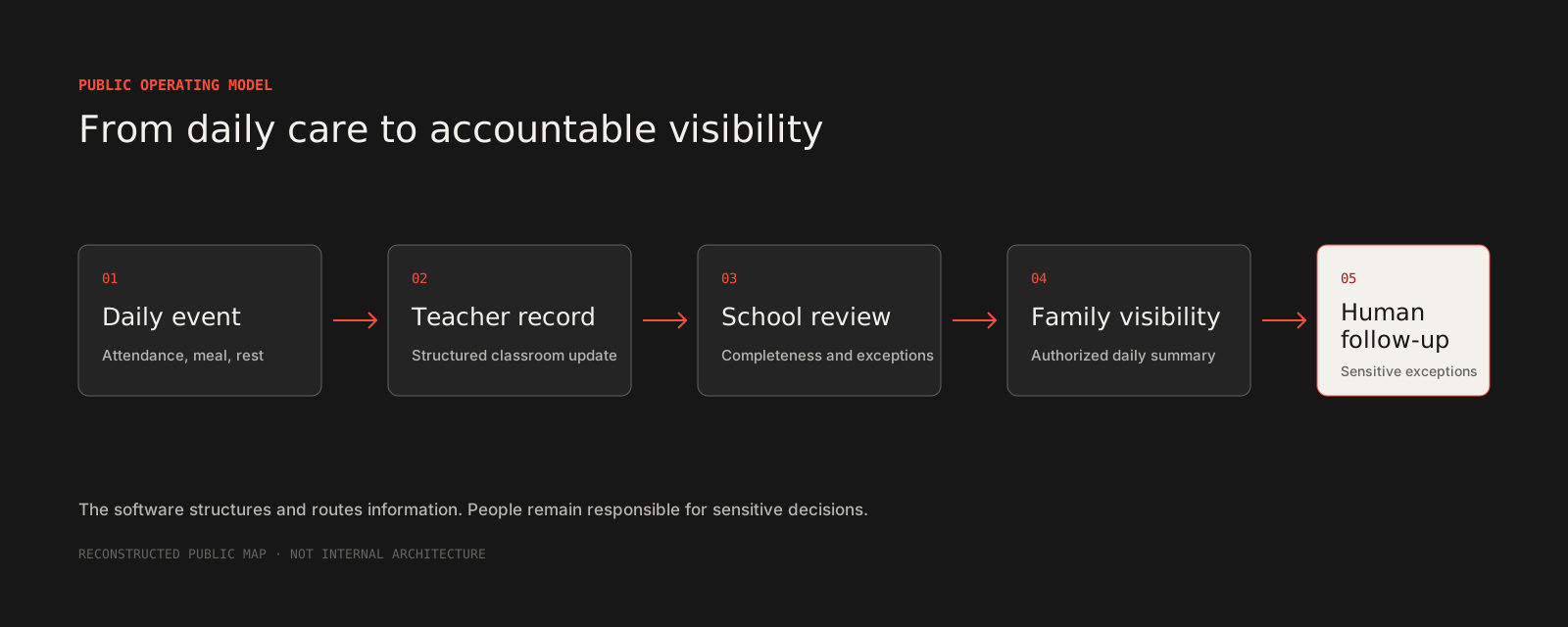
This public case follows one path that is specific enough to inspect: a daily care event becomes a structured record, is reviewed by the school and reaches the right family.
A school day is more than a list of updates
A preschool day creates a continuous stream of responsibilities. Attendance, meals, rest, activities, health observations, transport and family communication all need to reach the right person with enough context to act. For a teacher, these records are part of caring for children. For a school operator, they show whether the daily work is complete and which exception still needs attention. For a parent, they explain their child’s day.
When those records live in separate messages or informal handoffs, the problem is not simply missing information. School operators cannot see whether daily care has been recorded consistently, teachers repeat updates across channels and parents may receive an incomplete view of the day.
Health notes, medication, absence reasons and transport exceptions cannot be treated as ordinary notifications. Software can place them in the right queue, but an authorized person still needs to review the context and decide what happens next.
From fragmented updates to an operating record
Before
Daily classroom records can be fragmented across paper, spreadsheets, chat messages and individual memory. Each tool may contain part of the truth, but responsibility becomes difficult to follow from a classroom event to school oversight and family communication.
Intervention
Kindie connects role-specific web and mobile experiences around the same operating record. Teachers record attendance and daily care. School teams review completeness and exceptions. Parents receive the information they are authorized to see. Drivers and agency operators work within their own bounded responsibilities.
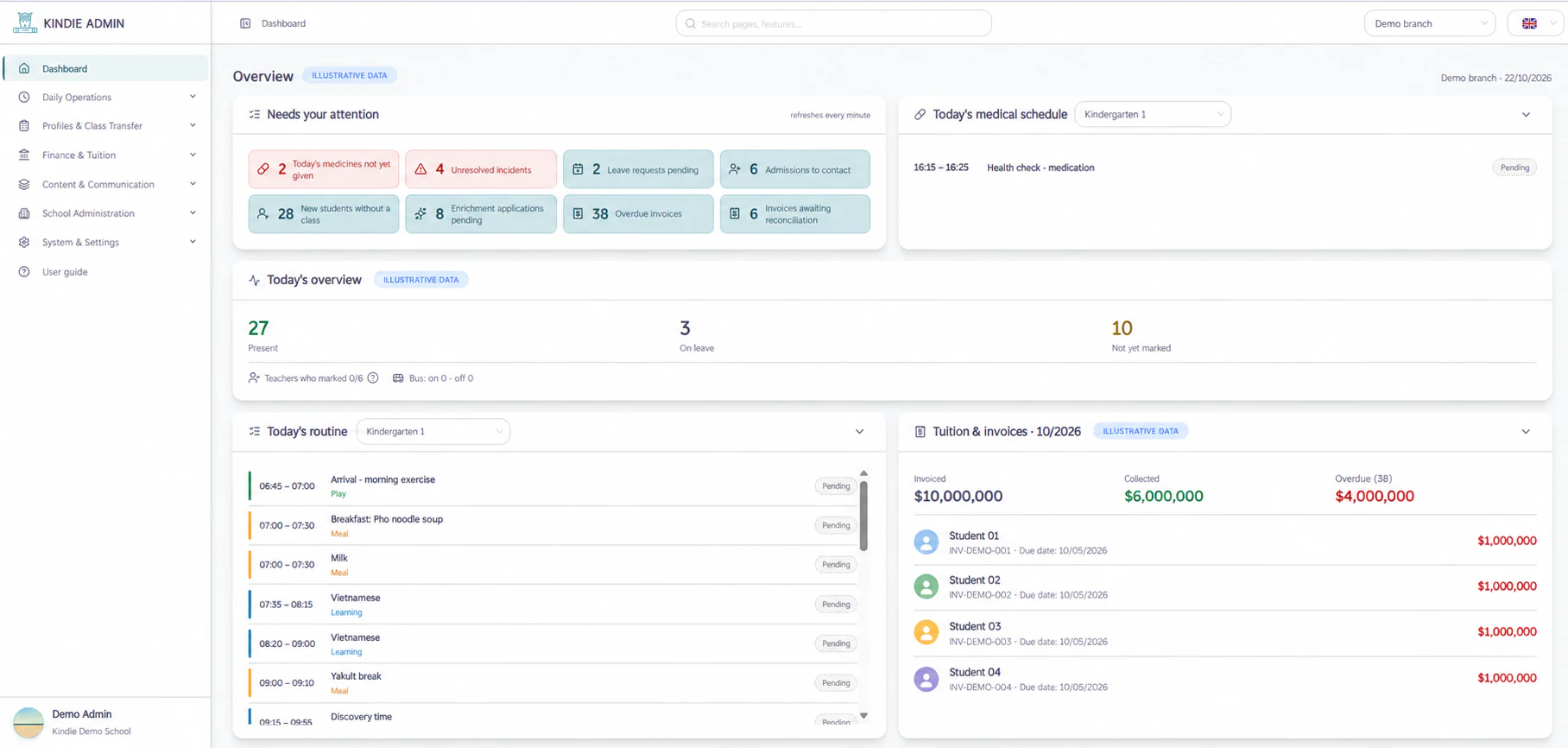
The administration overview brings attention queues, the medical schedule, attendance, the daily routine and tuition exceptions into one operator surface. The purpose is not to automate every decision. It is to make incomplete work and sensitive follow-up visible to the authorized person.
The wider product supports admissions, enrollment, classes, transport, health records, communication, fees, payments and reporting. These capabilities provide the surrounding school lifecycle, but they are not presented here as a feature inventory.
Current state
Kindie is an in-production, multi-branch and multi-tenant platform with seven years of operational history. A shared product foundation can support configurable white-label contexts while keeping schools, branches, classes and authorized users within the appropriate operating boundary.
Public evidence
- The production product connects school administration, teacher, parent, driver and agency responsibilities through role-specific surfaces.
- The platform has been developed and operated for seven years.
- One operating model supports multiple schools, branches and configurable white-label contexts.
- Web administration, mobile applications and a production PWA provide experiences appropriate to different operating roles.
- Daily classroom records can connect attendance, care updates, school review and authorized family visibility.
- Attention queues place medication follow-up, incidents, leave requests, admissions and invoice exceptions where an authorized operator can review them.
- Sensitive health, medication, child and family information remains permission-bound and requires human responsibility.
Processing time, number of manual steps and completion rate have not been measured to the publication standard for this case. No before-and-after performance claim is made.
Public operating model
- Daily event: attendance, meals, rest, activities or another care event occurs during the school day.
- Teacher record: the teacher creates a structured update in the context of the appropriate class and child.
- School review: authorized school staff can check completeness and identify an exception that needs attention.
- Family visibility: a parent receives only the approved information associated with their child.
- Human follow-up: health concerns, medication, absence reasons and other sensitive exceptions remain the responsibility of an authorized person.
My role and the team’s responsibility
I work on Kindie as a product builder, with responsibility for product direction, solution architecture and product operations. My job is to connect the school lifecycle, daily classroom work and family communication into an operating model that the team can continue to build and run.
The ZiniSoft team designs, builds, tests and evolves the administration, agency and mobile experiences. Teachers and school operators remain responsible for the accuracy of daily records. Parents decide how to act on the information available to them. Sensitive decisions about children, health, medication, attendance exceptions and financial records remain with authorized people.
Decisions and trade-offs
One operating record, role-specific experiences
A school administrator, teacher, parent, driver and agency operator do not need the same interface. Kindie separates their daily experiences while connecting them to the same controlled operating context. This increases the number of product surfaces, but avoids forcing every role through a generic interface with excessive access.
Visibility follows responsibility
Fast communication is useful only when the recipient and context are correct. Parent visibility is therefore bounded by the relevant child and approved record. School oversight has a broader view, but remains permission-controlled. The trade-off is more access and context management in exchange for safer, more accountable information flow.
Shared platform with configurable brands
A shared product foundation reduces divergence across white-label contexts and makes common operating improvements reusable. The cost is that shared changes must be checked across brand, branch and role contexts before release.
People retain sensitive decisions
The product can structure health notes, attendance exceptions and care updates. It does not own the judgment that follows. A person reviews sensitive information, contacts the family when appropriate and remains accountable for the action taken.
What Kindie taught me
After seven years, the most important lesson is that a product is not finished when a release reaches production. Value appears when the system continues to fit the real work, while the team can see what is working, what is causing friction and who is responsible for improving it.
Kindie also shaped how I approach later products: start with work as it happens, identify who keeps the decision and only then choose what software should structure or AI should assist.
Publication boundary
This case demonstrates how daily preschool care can become an accountable information flow across multiple roles and branches. It does not disclose school or customer names, child or parent records, photos, health details, medication, attendance history, fees, phone numbers, infrastructure, private endpoints or internal architecture.
The product screenshot has been sanitized with fictional data and explicit illustrative labels. The system map is reconstructed. The case does not claim a measured reduction in processing time, manual effort or completion rate. Deployment counts and identifiable white-label brands remain outside the public case.